
Working Together Toward Financial Literacy

Brian Denysuik, President & CEO of Creditaid, Manitoba’s largest independent credit counselling agency, had the pleasure of attending two events today with the Financial Consumer Agency of Canada.

The first event was the launch of the senior’s strategy for financial literacy. The seniors’ strategy, Strengthening Seniors’ Financial Literacy, is the first phase of the national strategy for financial literacy.  Its publication follows a series of consultations with a broad range of public, private and non-profit organizations as well as individual Canadians. The strategy sets out goals relevant to increasing the financial literacy of seniors. More information can be found here.

Kevin Sorenson, the Honorable Minister of Finance and Jane Rooney, our National Financial Literacy Leader were in Winnipeg for this event.
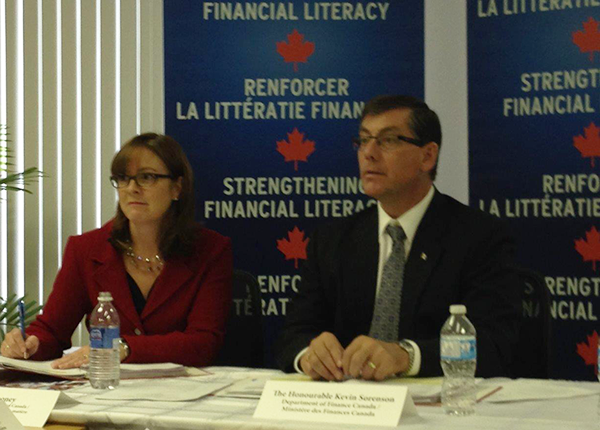
Jane-Rooney-and-Kevin-Sorensen---Oct-16-Financial-Literacy


The event provided the opportunity to participate in a stakeholder consultation session on strengthening the financial literacy of specific priority groups. Stakeholders in attendance were able to offer feedback and commentary to both Jane Rooney and Minister Sorenson.
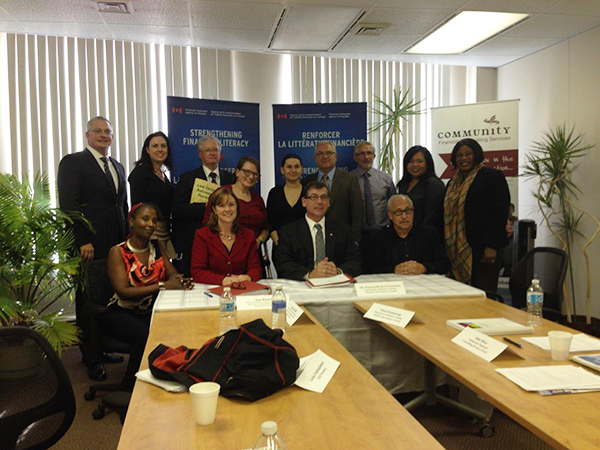
Working-Group---Oct-16-Financial-Literacy-Event


It was evident that financial literacy is a critically significant issue for our federal government.

Please refer to Toward a Financial Literacy Strategy for Priority Groups for more information on the strategy goals.

Brian Denysiuk will also be attending the by-invitation-only National Conference on Financial Literacy, to be held in Vancouver in November.


Honoured to Support St. Amant

Longtime readers of our blog will undoubtedly recall our work with the St. Amant Centre.

We are incredibly honoured to work with the dedicated members of the  St. Amant and Winnipeg communities who have come together over the years to lend their support to this extremely worthy cause, which acts as a resource for Manitobans with developmental disabilities and autism.

On September 27th, Creditaid teamed with a number of local businesses, including title sponsor National Bank, to present the St. Amant Free the Spirit Festival. Our staff were on hand and ran the bean bag toss for St. Amant residents and the general attending public. Both our crew and the participants had a great time at our booth.

The management of Creditaid would like to take this opportunity to thank its staff and their families for helping out at this event. Together, we raised over $175,000 for the Centre.

Congratulations to everyone – your hard work is showing off and the St. Amant Centre is the beneficiary of your dedication.

National Conference on Financial Literacy

Brian Denysuik, President & CEO of Creditaid and Vice President of the Canadian Association of Independent Credit Counselling Agencies (www.caicca.org) is very excited to have been invited by The Financial Consumer Agency of Canada to their National Conference on Financial Literacy this November.

The 2014 national conference will take place in Vancouver, British Columbia and will showcase the expanding array of creative approaches to increasing financial literacy in Canada from grass roots groups, dedicated government and NGO leaders and respected corporate partners.  The focus of this year’s conference will be “Strengthening Financial Literacy Through Collaboration” and this approach will permeate throughout the programming and roundtable discussions of the event.  Attendance to this conference is by invite only.

Learn more about this conference at http://www.fcac-acfc.gc.ca/Eng/financialLiteracy/initiativesProjects/events/Pages/home-accueil.aspx.

Free The Spirit Festival This Saturday

We are very excited for the Free The Spirit Festival happening this Saturday, September 27th at St. Amant.  This is a great event that celebrates the value of people with developmental disabilities and autism.  We invite all of our friends, staff and the whole community to join us on that day as we participate in the fundraising walk and have fun at the many activities we have planned for the day.  There will be a BBQ, games, music and a petting zoo – activities for the whole family!


Date: Saturday, September 27th, 2014
Time:  10 am – 2pm
Location: St. Amant at 440 River Road

For more information, visit the St. Amant website or give us a call at 204.987.6890.  See you there!


Back to the Grind – Tips for the University and College Students

With the unofficial end of summer upon us, this can only mean that once again, it is time to head back to school.

Are you a university or college student heading back to the campus this fall? We know how stressful it can be to manage finances while balancing course work, extra-curricular activities and a part time job.  From tuition to textbooks, all the expenses associated with going to school can quickly add up so that is why we have a few quick tips for you today to help you survive your school year.  Afterall, we believe that developing a budget and managing finances is an important life skill to learn outside of the classroom.

Budgeting for University Students

Develop a Budget

Now is the perfect time to develop a budget of your expenses for the school year.  The budget will help you see how much is coming in from jobs, grants, bursaries or loans and how much will need to go out for bills and other expenses.  Having this understanding will help you plan out your finances so that you can do everything you want to do throughout the school year.

Your Wants vs Needs

As you’re preparing this budget, it is important to distinguish between “needs” and “wants”.  For example, while you need food to live, going out to eat with friends at a restaurant is a ‘want’ that will be a lot of more expensive.  Find a balance between the two so that you can live comfortably without missing out.

Types of Expenses

Break down your expenses so that you have a better idea of what you need each month.  Which of your expenses are one time and which are monthly?  For example –

School Costs – such as tuition, textbooks, course fees you can expect to be once a term

One Time Expenses – trips, gifts, moving costs are one-time expenses and can happen unexpectedly

Monthly Expenses – for food, rent, cell phone, gym memberships, or gas are monthly expenses that will remain mostly the same each month

Understanding how much you will need and when you will need it by will help in your overall planning.

The key is developing a budget that is realistic to your situation.  When you have this understanding of what’s coming in and going out, you can make better and more informed decisions when you are deciding, for example, on whether to go out for dinner or commit to that trip to Toronto during Reading Week.

We wish you a great school year ahead!

New Couples and Money

Couples and Money Management

You’ve just moved in with your current love or maybe you’ve just got engaged. This is a happy, exciting time in your life. The two of you may have discussed how many kids you want, where to go on a honeymoon or where your dream house will be. But have you been truthful with each other with regard to your finances and credit rating? Everything listed above costs money and both of you need to be honest with each other regarding your finances in order to have those things.

I am not suggesting that you open joint bank accounts or sign over your pay check to your spouse. I know many couples that do but I also know many who retain separate banking and finances. Either arrangement is fine as long as you both are happy with it. As you begin a new, permanent relationship, it is time to set your financial goals as a couple and to be honest about your money values.

Here are things you need to discuss now.

  1. What is your net worth? This is a list of your current assets and liabilities. An asset is an item that you could sell and receive money for.  For most of us this means real estate, cash in our bank accounts, RRSP’s and vehicles. Liabilities are your debts.  Ideally your assets should be higher than your liabilities. If so, you have a positive net worth. As you get older your net worth should increase.  How do each of your net worth statements compare? Are you both in agreement concerning your net worth goals? This is important because your net worth can determine when you will be able to buy that dream home, afford to have children or when you can retire.Do you have a negative net worth because of a student loan? Young people often do.  Student loan debt is considered acceptable if the amount of the debt is in relation to the type of education received. For example, many new doctors and dentists graduate with student loan debt in the $150,000 range. Given the fact that they have the potential for a very high income, this level of debt is reasonable and can be paid off in less than 10 years.
  2. Go online and order a copy of your credit bureau if you have not done so recently. Share it with your partner.  Are your scores and credit patterns similar? Or does one of you buy most things using credit, carry balances each month and pay hundreds of dollars in interest charges? Does the other hate debt (and interest charges) and pay off all their credit cards each month?  If you each have very different credit habits and attitudes toward debt, there could be a real problem in the future. If one spouse has a poor credit history, it could prevent the other from reaching financial goals as a couple, like buying a house.  Spouse A, with the minimal debt and excellent credit history could help Spouse B increase their credit score by co-signing a consolidation loan so that high interest credit cards can be paid off and cancelled. If every loan payment is made on time, Spouse B’s credit score will improve. This in turn will benefit both spouses by way of a lower interest rate if they make a joint purchase like a house or car.
  3. How are you going to manage your day to day expenses? Some couples close their individual accounts and open a joint bank account. All their money gets deposited and withdrawn by either person from this bank account. It sounds like the most convenient way to handle expenses but it can cause big problems. Who is depositing the money and who is withdrawing the money? And for what reason? This strategy works the best for couples who both manage their money well. So before you decide how you are going to handle your banking, it would be wise to write up a monthly budget then decide who will be responsible for paying for what. Some couples maintain separate banking for their entire relationship. Each is responsible for paying some of the joint bills. For example, the wife pays for the groceries and the husband pays the rent. Some couples use a hybrid of both methods in which each maintain a separate bank account and pay their own individual expenses but both deposit a set amount to a joint bank account and joint expenses are paid from it. But how much should each contribute to the joint bank account? Some couples each deposit the same amount of money, for example, $2000 per month. Other couples each contribute a percentage of their income. Once you have come to an agreement, talk about what will happen if you have kids. What will happen if one spouse’s income is reduced because of maternity leave?
  4. What are your long term goals?This is important to establish early in a relationship because you may discover you have radically different financial goals. If one of you is happy to rent forever and basically spend every dime on travelling or entertainment, but the other spouse wants to save up for a house and early retirement – the relationship is doomed to fail. We all hear that ‘opposites attract’. This may be true for a short period of time. For long term happiness and peace in the household your goals and dreams need to be aligned. You need to be honest with yourself and each other as to what is important to you and where you see yourself financially in 10 or 20 years. If your goals differ, determine if you are both willing to compromise. Staying in a committed relationship is hard work and can be stressful. Having money problems adds even more stress.

Laurie Boudreau is a credit counsellor with Creditaid. Contact her now for help with managing your money and your debt.

BC Driving to Change Legislation that Manitoba Adopted Two Years Ago to Protect Manitobans

Creditaid President and CAICCA Vice Chair Brian Denysuik was recently interviewed by The Province on the need for the BC government to adopt changes in their debt management legislation.  The province has the highest rate of consumer debt in the country but current legislations leave consumers open to financial harm and loss of funds from debt settlement companies during their most vulnerable times.

BC Debt Management Legislation

Changes to the Manitoba legislations were made in 2012 and Brian comments on how those changes were instrumental in protecting Manitobans from scams. “The changes around debt settlement here in Manitoba…have worked very, very well.  I think the legislative changes have helped protect consumers. I fail to understand why BC has not done the same thing.”

“Before the Manitoba government changed that province’s regulations in February 2012, ‘we were seeing a lot of people get trapped into working with these organizations, where they had turned around and they had sent them a whole bunch of money, only to be sued, only to find out that they’d been scammed,’ Denysuik said.

Denysuik said in recent years, his office has heard from far fewer upset, distressed consumers who claim to have been scammed by shady debt settlement companies.”

Read the full article on The Province, originally posted on August 22nd, 2014. Click here to be redirected to the article.

Can you relate to this divorce debt story?

John’s motto was always “work hard and play hard”.  John had worked hard his entire career which often was his justification for the money he spent drinking, dining out, clothes and on his home.   He was living the high life and he felt it was all justified.

If he had taken the time to figure out how much he was spending in relation to his income, he would’ve realized he was spending more than he was making.  His bank account was often overdrawn and he was using one credit card to pay off the other.

His heavy drinking was only contributing more to his debt problems.  Finally, it became so excessive that it drove his wife away.  The divorce was the final straw.  The drawn out divorce process and court proceedings resulted in his assets being frozen.  He could not borrow money or sell any of his assets to make his payments. He was in a standstill.

debt help winnipeg

Some debt problems are years in the making.  When the pieces finally fall, things can quickly spiral out of control.  If your debt story is like John’s, stop the speed debting and seek professional help from the counsellors at Creditaid.

Are you ‘Speed Debting’ with your Business?

Get Debt Help WinnipegIt was always Jessica’s* dream to run her own business.  She had spent her childhood in a small town and loved the sense of community she felt living there so when it was time, it was an easy decision for her to pick the location for her business.

She ran a small convenience store and business was great. Her prime location and loyal customers made the business a success.  Her dream had come true.

An advantage of running a business in a small town is that competition is limited. For a long time, the big retailers never even considered entering Jessica’s town.  But the town grew and then one day, the big retailers came.

The business started to change. Business dropped and even the loyal customers couldn’t resist the low prices and convenience the big retailer offered.  Jessica’s over-extended line of credit became the working capital and pretty soon, her multiple credit cards were maxed out.  Her own income disappeared at a time when she needed it the most.  Every month became a juggling act of making rent and minimum payments.  She was afraid to answer the phone, open her mail or even see her family and friends for fear they would ask how business was going.

Financially, Jessica knew she was in trouble but the hardest part was accepting that she had to let go of her dream.  The mounting debt and the stress of trying to figure it all out by herself finally made her ask for help.

When debt starts mounting, the situation can quickly spin out of control.  To avoid a speed debting problem like Jessica’s, talk to the counsellors at Creditaid.

What to Do with the Wedding Ring after Your Divorce

When a relationship ends, the items that held special meaning before can become bearers of painful reminders. Engagement and wedding rings, wedding dresses and marriage certificates are items that many people wonder about after the end of their relationship.  What can you do with them?

Engagement rings and wedding rings often come with a big price tag and if the items lose their emotional value, there is the option to sell them.  Jewellers sometimes will buy their pieces back but at a significant discount.  On average, they will buy them back at only 35% of original value.

Many people in similar situations have opted to sell their rings online through websites such as “I Do… Now I Don’t”.  The founder, Joshua Opperman, was left with a ring after his engagement ended prematurely which prompted him to found the jewellery auction site to help others in similar situations part with their rings.  He has since been featured on Rachael Ray, CNN, and Whoopi Goldberg.

One important factor when selling your high valued item online is to minimize risk of scam.  On “I Do…Now I Don’t”, sellers can list their rings for free.  Once the item is purchased, the money is held in escrow by the website.  The seller will send the ring in for authentication by GIA-trained gemologist.  Once the ring has been authenticated, the ring will be sent to the buyer via UPS with insurance included and a bank cheque will be mailed out to the seller.

Sellers will typically receive 40 – 60% of the retail price for their item, minus a 15% commission fee. If you are making payments on the ring, this return can help you substantially in reducing your debt.

Parting with your engagement or wedding ring might give you the emotional detachment you need to help you move forward past the relationship and onto something better! Visit https://www.idonowidont.com/ for more information.